“I’ve tried several social stories, but these were the first ones my students connected with right away. They’re simple, clear, and so easy to use.”
Emliy
These resources save me so much time. Everything is leveled, organized, and ready to use. My readers with the most difficulty are finally showing progress I can track.
Cater
I printed the first week and saw improvement by day three. The blending practice + passages combo is powerful.
Sarah
Most teachers frequently buy all 3 together
YOUR SELECTION:
3
BUNDLES FOR
$9.90
★★★★★4.85(134 reviews)
✓
+
✓
+
✓
Bundle total
$9.90
48 Social Stories MEGA BUNDLE
Looking for an easy way to help children understand positive behavior,
emotions, classroom expectations, and everyday social situations?
This collection of short, child-friendly social stories helps students
understand not only what they should do, but also why certain choices matter.
The stories use simple language and relatable situations, making them useful
for classroom discussions, social-emotional learning, and behavior support.
What Makes It Special?
Engaging:
Short, easy-to-follow stories designed to keep students interested.
Real-Life Relatability:
Covers situations children regularly experience at school and in everyday life.
Classroom Conversations:
Use the stories as starting points for meaningful discussions with students.
Easy to Use:
Clear and simple wording makes the lessons easier for children to understand.
Versatile:
Includes resources suitable for both printable and digital use.
Editable:
Customize the materials to better suit your classroom, students,
and individual situations.
What is included:
48 Printable PDF Mini Stories - Color
48 Printable PDF Mini Stories - BW
48 Digital PDF Mini Stories
Editable PPT version
Stories Included:
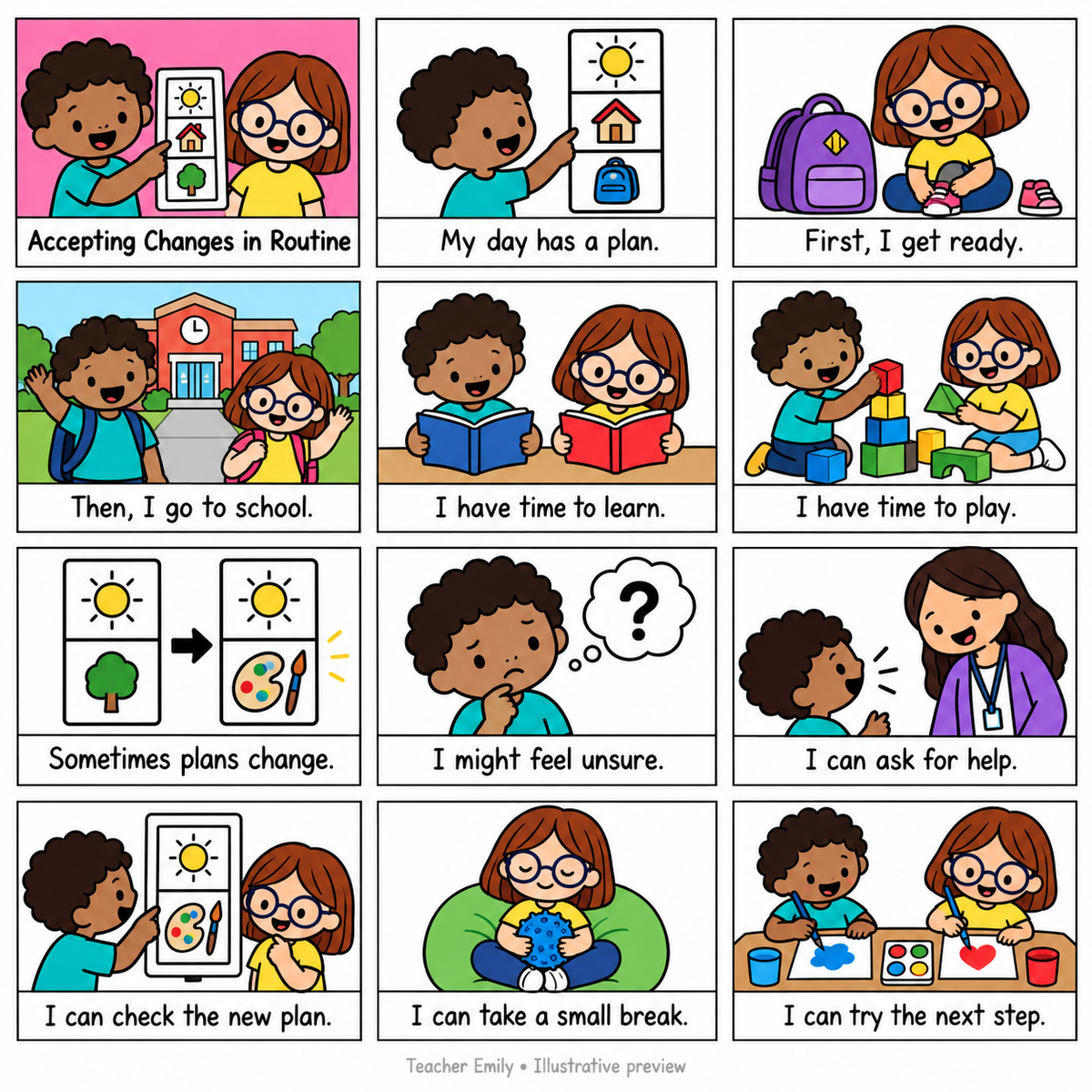
Accepting Changes in Routine
Accepting No
Accepting Consequences
Appropriate Touches
Asking For Help
Bathroom Expectations
Being Kind
Small Problem vs. Big Problem
Doing My Work
Feelings and Emotions
Feeling Frustrated, Angry, or Upset (Calming Strategies)
Following Directions
Going on a Field Trip
Going to School (Separation Anxiety)
Hallway Expectations
Hands Out of My Pants
Hygiene
Keep Clothes On
Listening to the Teacher
Making Mistakes
No Biting
No Hitting
No Screaming
No Spitting
Not Getting My Way
Personal Space
Playing with Friends
Potty Training
Riding The Bus
Running Away
Safe Hands
Saying Bad Words
Self Control
Sharing
Staying on Task
Taking Turns
Telling the Truth
Think It, Say It - Social Filter
Transitions at School
Winning and Losing
Recess
Solving Problems with Friends
Picking My Nose
Cafeteria Expectations
Covering Coughs and Sneezes
Raising My Hand
Fire Drills
Making Loud Noises in Class
Why It Works
Children often learn best when expectations are explained through situations
they can recognize and understand. These social stories turn common classroom
and everyday challenges into simple learning opportunities.
Instead of only telling students what behavior is expected, the stories can
help them understand the reasons behind those expectations. Teachers and
parents can use them to encourage conversations about emotions, self-control,
decision-making, and appropriate responses.
THIS DONE-FOR-YOU BUNDLE MAKES
LEARNING EASY AND FUN!
Help students learn important social and behavioral skills through
engaging activities.
Spend less time searching for individual resources because everything
is conveniently available in one collection.
Follow a simple resource that makes it easier to introduce and reinforce
important concepts.
Keep useful stories ready whenever a new classroom or social situation
needs to be discussed.
WHY YOU SHOULD CHOOSE THIS BUNDLE
Save money by getting a large collection of resources
together instead of purchasing similar activities individually.
Save time by having ready-to-use materials available
whenever you need them.
Support your students with resources covering a wide
range of everyday situations.
Practice a wide variety of skills including emotions,
behavior, communication, classroom expectations, and social interactions.
Use the stories individually or select the ones that best match what
your students are currently learning or experiencing.
Disclaimer: This is a digital product that will be delivered
electronically. No physical product will be mailed.
The bundle includes 48 printable PDF mini stories in color,
48 printable PDF mini stories in black and white,
48 digital PDF mini stories, and an editable PPT version.
The stories cover a wide variety of everyday situations including
emotions, following directions, personal space, sharing, taking turns,
making mistakes, classroom expectations, transitions, winning and losing,
and many other social and behavioral situations.
Yes. The bundle includes printable PDF versions in both color
and black and white, allowing you to print the stories for
classroom or learning use.
Yes. Digital PDF versions of the social stories are included
in the bundle, making them convenient to use on digital devices.
Yes. An editable PPT version is included, allowing you to
personalize the materials for your classroom and students.
These resources can be used by teachers, educators, and parents
who want to support children with social skills, emotional
understanding, classroom expectations, and everyday behaviors.
This is a digital product. The resources are delivered electronically,
and no physical product will be shipped by mail.
You can use individual stories to introduce classroom expectations,
discuss emotions and behavior, prepare students for everyday situations,
or start conversations about social skills and appropriate choices.
Choosing a selection results in a full page refresh.


 ✓
✓
 ✓
✓